The Flat Rate VAT Scheme can make VAT accounting simpler for limited companies and, in some cases, reduce the amount of VAT you pay to HMRC.
It isn’t suitable for every business, though. In particular, the limited cost business rules mean that many consultants, contractors and other service-based companies now receive little or no financial benefit from using the scheme.
In this guide, we look at how the Scheme works, which businesses are eligible, and whether it is likely to be suitable for your company.
Flat Rate VAT – the basics
The Flat Rate Scheme makes the calculation of VAT far simpler than the standard scheme.
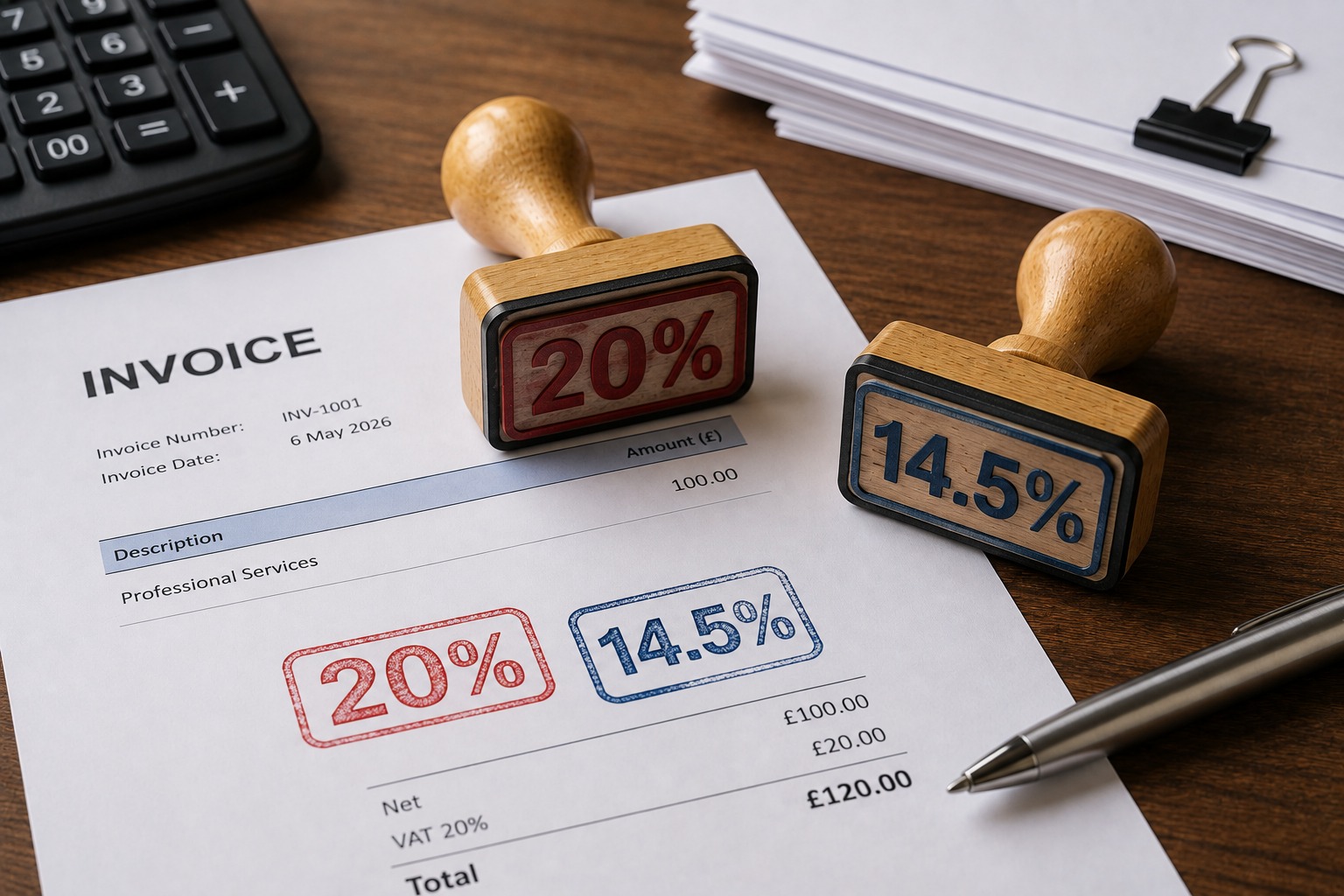
Although you charge clients and customers the standard 20% VAT rate on invoices for standard-rated supplies, you repay VAT to HMRC at a fixed rate percentage of your VAT-inclusive turnover.
If you are an IT contractor, for example, the percentage is 14.5% (or the applicable percentage for your occupation or profession). However, if your company is a limited cost business, the rate is 16.5% regardless of your sector. You can see HMRC’s current Flat Rate VAT percentages here.
Whether or not you are financially better off operating through the Flat Rate VAT Scheme will depend on your own circumstances.
If you buy a lot of equipment, for example, you may not benefit, as you generally cannot reclaim the VAT on purchases.
Flat Rate VAT Scheme – key facts
These notes and the following example calculation apply to businesses not caught by the limited cost business rules.
- In your first year of VAT registration, you receive an extra 1% reduction in the flat rate percentage you apply. In the case of an IT consultancy that is not a limited cost business, for example, you may repay 13.5% rather than 14.5%. The reduction applies for the first 12 months after VAT registration, rather than the first 12 months after joining the Flat Rate Scheme.
- You can join the scheme if you are VAT registered and expect your VAT taxable turnover (excluding VAT) to be £150,000 or less over the next 12 months.
- The VAT registration threshold is currently £90,000 (2026/27). If your taxable turnover over the previous 12 months exceeds this, you will normally need to register for VAT. There is also a separate test if you expect your taxable turnover to exceed £90,000 in the next 30 days alone.
- If you outlay £2,000 or more on a single purchase of qualifying capital expenditure goods (including VAT), you can usually claim the input tax on your VAT return in the normal way.
- Although you pay back a lower percentage under the scheme, you should continue to invoice clients at the normal VAT rate that applies to your supplies (currently 20% for standard-rated services).
- Your company can elect to leave the Flat Rate Scheme at any time.
- You can normally continue in the Flat Rate Scheme unless your total income, including VAT, exceeds £230,000 at the relevant annual test. There is also a forward-looking £230,000 test in some circumstances.
Limited cost business rules exclude many small companies
Unfortunately, many small businesses cannot benefit from the Flat Rate Scheme.
Since April 2017, businesses deemed to be ‘limited cost businesses’ cannot use the more beneficial flat percentage rate which would normally apply to their trade or profession.
Instead, they have to use a fixed 16.5% rate, which means that joining the Flat Rate Scheme may not be beneficial, and the standard VAT scheme may be the better bet.
Are you a limited cost business?
A limited cost business is one where the amount spent on relevant goods, including VAT, is either less than 2% of its VAT flat rate turnover in the relevant accounting period, or more than 2% but less than £1,000 per year.
If your VAT return covers less than a year, the £1,000 figure is reduced proportionately. For a quarterly return, for example, the figure is £250.
The test is applied for each VAT accounting period, so a business can potentially use the 16.5% limited cost rate in one period and its normal sector rate in another.
The definition of relevant goods includes items used solely for the purposes of the business, but does not include capital expenditure goods, food and drink for you or your staff, most vehicle costs, or services.
These exclusions prevent businesses from using everyday expenses or one-off capital purchases to raise their costs above the limited cost threshold.
The following classic contractor costs are excluded, as they are not ‘relevant goods’:
- Accountancy fees
- Advertising costs
- ‘Anything provided electronically’ – e.g. downloads
- Software you have downloaded, or bespoke software
- Office rent
HMRC has issued detailed guidance on the limited cost business rules which can help determine what items qualify as relevant goods.
For example, any item used fully or partly by a business owner or employee in their private capacity cannot be considered to be relevant goods.
Capital expenditure goods are also specifically excluded from the limited cost business test. This means that buying a computer, mobile phone, printer or piece of office furniture will not normally help a business exceed the 2% cost threshold simply because it has made a sizeable one-off purchase.
How much worse off are you if you’re a limited cost business?
Under the limited cost business rules, many companies which would normally use flat rates of between 12% and 14.5%, depending on their sector, find themselves paying a fixed 16.5% rate.
In financial terms, this represents a significant tax hit for many.
For example, if you’re not a limited cost business and your turnover for the year was £75,000, your VAT-inclusive turnover is £90,000. If you’re a typical IT contracting company, you repay 14.5% x £90,000 = £13,050.
However, if you’re a limited cost business, you pay 16.5% x £90,000 = £14,850 – an increased tax hit of £1,800.
Flat Rate VAT Scheme – example
Here is an example for a limited company with gross client billings of £40,000, and VAT on expenses incurred of £500.
Standard VAT calculation
Total billings @ £40,000
Output VAT @ 20% = £8,000
(minus) Input VAT @ £500
Total VAT payable would be £7,500.
Flat Rate Scheme
Total billings @ £40,000
Output VAT @ 20% = £8,000 (added to total for purposes of calculating Flat Rate VAT)
For an IT consultancy which is not a limited cost business, total VAT payable would be 14.5% of £48,000 = £6,960.
However, if the same company is a limited cost business, it would pay 16.5% of £48,000 = £7,920.
This example uses the 14.5% rate applied to computer and IT consultancy or data processing businesses. Other professions and occupations may have different rates.
Don’t forget that you have a 1% reduction in the percentage you pay to HMRC during your first year of VAT registration.
Whether the Flat Rate Scheme is worthwhile depends on your own circumstances, particularly the rate which applies to your business and whether you are caught by the limited cost business rules.
If you’re unsure whether the Flat Rate Scheme is right for your business, get in touch with the Integro team. We can check which rate applies to your business, whether the limited cost rules affect you, and whether the Flat Rate or standard VAT scheme is likely to work better for you.
For more information, consult HMRC’s guide to the Flat Rate VAT Scheme, which includes detailed guidance on how the scheme works, or see the current Flat Rate VAT percentages.