Most limited companies pay for professional help at some point, even if it’s only an accountant to prepare your annual accounts and Corporation Tax return.
Your company can normally claim these costs as business expenses where they are incurred wholly and exclusively for the purposes of the business. The same applies if you pay a bookkeeper, tax adviser, solicitor or another professional to carry out work for the company.
However, the tax treatment is different if the advice or service is for you personally, rather than the business.
Accountancy fees
Accountancy fees are one of the most common expenses for small limited companies.
If you pay an accountant to deal with the company’s accounts and tax affairs, the fees will normally be deductible from the company’s profits.
Depending on the service you use, your accounting fee might cover:
- Annual accounts.
- Corporation Tax returns.
- Payroll and PAYE.
- VAT returns.
- Companies House filings.
- Bookkeeping.
- Tax advice relating to the company.
Many accountants charge a fixed monthly fee covering some or all of these services. It doesn’t matter that you’re paying monthly rather than settling a single annual bill – it is still an accounting cost incurred by the company.
You can also claim additional accountancy fees where you need work carried out outside your normal accounting package.
What about your personal tax return?
There is an important distinction between accounting work carried out for your company and work carried out for you personally.
The cost of preparing the company’s annual accounts and Corporation Tax return is a company expense.
However, the cost of preparing your personal Self Assessment tax return is not a valid business expense.
In practice, some limited company accounting packages include the director’s Self Assessment return at no additional cost. If there is no separate charge for the personal work, there is no additional personal fee to account for.
However, if your accountant charges separately to prepare your personal tax return, you should pay this out of your own pocket.
Bookkeeping costs
If you use a bookkeeper to keep the company’s records up to date, the company can normally claim the full cost.
A bookkeeper might reconcile your bank transactions, process invoices and receipts, maintain the accounting records or prepare information for your accountant.
These are all standard services carried out for the business.
Tax advice
Your company can claim the cost of professional tax advice where it relates to the company’s business and tax affairs.
For example, you might ask an accountant or tax adviser for help with:
- Corporation Tax.
- VAT.
- PAYE and payroll.
- Capital allowances.
- Buying equipment or other business assets.
- The tax treatment of a company transaction.
Again, you need to be aware of the distinction between company and personal advice matters.
Advice relating to the company’s Corporation Tax liability is clearly a company cost. Advice solely about your own personal investments clearly isn’t.
Sometimes you might seek professional advice which covers both you and your company. If that happens, ask the adviser to identify the company and personal elements of the bill where possible.
Legal fees
Legal fees can also be claimed where the solicitor or other legal professional is acting for the company in connection with its business.
A small company might incur legal costs when:
- Reviewing or preparing a commercial contract.
- Dealing with a customer or supplier dispute.
- Taking on business premises.
- Recovering an unpaid business debt.
- Obtaining advice on an employment matter.
- Dealing with another legal issue affecting the company.
However, even when legal costs relate only to the company, the tax treatment may vary.
Some legal costs are connected with the purchase or disposal of a capital asset rather than the company’s day-to-day trading activities. These may need to be treated as capital expenditure rather than deducted as an ordinary business expense.
Read more in HMRC’s guidance on professional fees and expenses.
Legal fees relating to the purchase or sale of an asset may need to be treated as capital expenditure, so check with your accountant before assuming that all fees are recorded as ‘revenue’ expenses (standard business costs).
Other professional advisers
Accountants and solicitors aren’t the only professional advisers you might encounter as a business owner.
Depending on what your business does, you might pay for the services of a surveyor, architect, engineer, consultant or another specialist.
The usual test always applies when it comes to expenses: the work must relate to the company’s business.
For example, professional advice obtained in connection with business premises may be a company cost, although the precise tax treatment will depend on the nature of the work.
Similarly, a company can pay for specialist consultancy where the work is being carried out for the business.
Professional fees before your company starts trading
You may pay for some professional costs our of your own pocket before your company actually starts trading.
Some pre-trading expenses can be treated as if they were incurred on the first day of trading, as long as they would have been allowable costs had the business already been actively trading.
The rules can apply to qualifying expenses incurred during the seven years before the trade begins.
Some accountancy, legal and other professional costs can qualify, provided they would have been allowable business expenses if the company had already started trading.
Which professional expenses can’t your company claim?
As we’ve already mentioned, you can never claim for professional costs which relate solely to your private affairs.
The fact that an invoice is produced by an accountant, solicitor or other professional doesn’t automatically mean it can be treated as a company expense.
Here are some typical examples:
- An invoice issued solely covering your personal tax return
- Legal advice about a personal matter.
- Advice about some investments you own personally.
- Professional services relating to your home or other personal property.
Some professional fees, particularly those linked to buying or selling assets, may need to be treated as capital expenditure rather than normal business expenses.
If a bill covers both company and personal work, only the company element should be treated as a business expense. Ask for a breakdown if the amounts aren’t shown separately.
What about VAT?
If your company is VAT-registered, it can normally reclaim VAT charged on professional fees where the service is supplied to the company and used for its taxable business activities.
Make sure the invoice is addressed to the company and keep it with your accounting records.
You can’t reclaim VAT through the company on professional services supplied to you personally.
Keep the invoices in a safe place
Keep invoices for any accountancy, legal or other professional fees paid by the company. Upload them to your accounting software package if you can, as both you and your accountant will be able to access them if necessary.
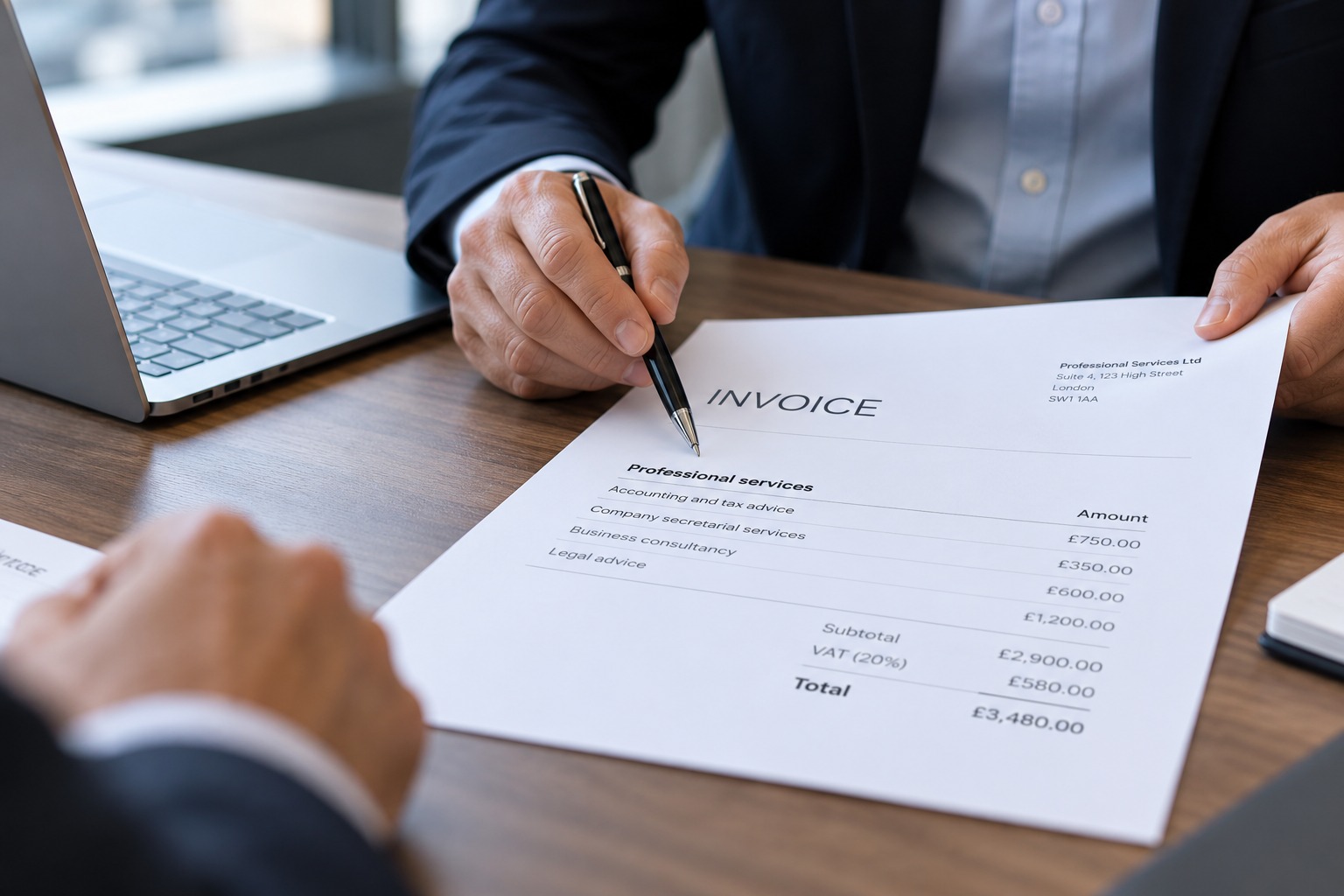
The invoice should show who provided the service, the work carried out and the amount charged.
This is particularly important for one-off legal or tax work, where it may not be clear from the payment itself what the advice related to.
Need more advice? Get in touch.
Accountancy, legal and other professional fees are common expenses for limited companies, and most costs which relate directly to running the business can be claimed.
If you’re unsure whether a particular fee is allowable, or how it should be recorded in your accounts, get in touch with the Integro team.
Click here to get in touch with the Integro team.
You can also read our complete guide to limited company expenses for more information on the costs you can claim through your limited company.