
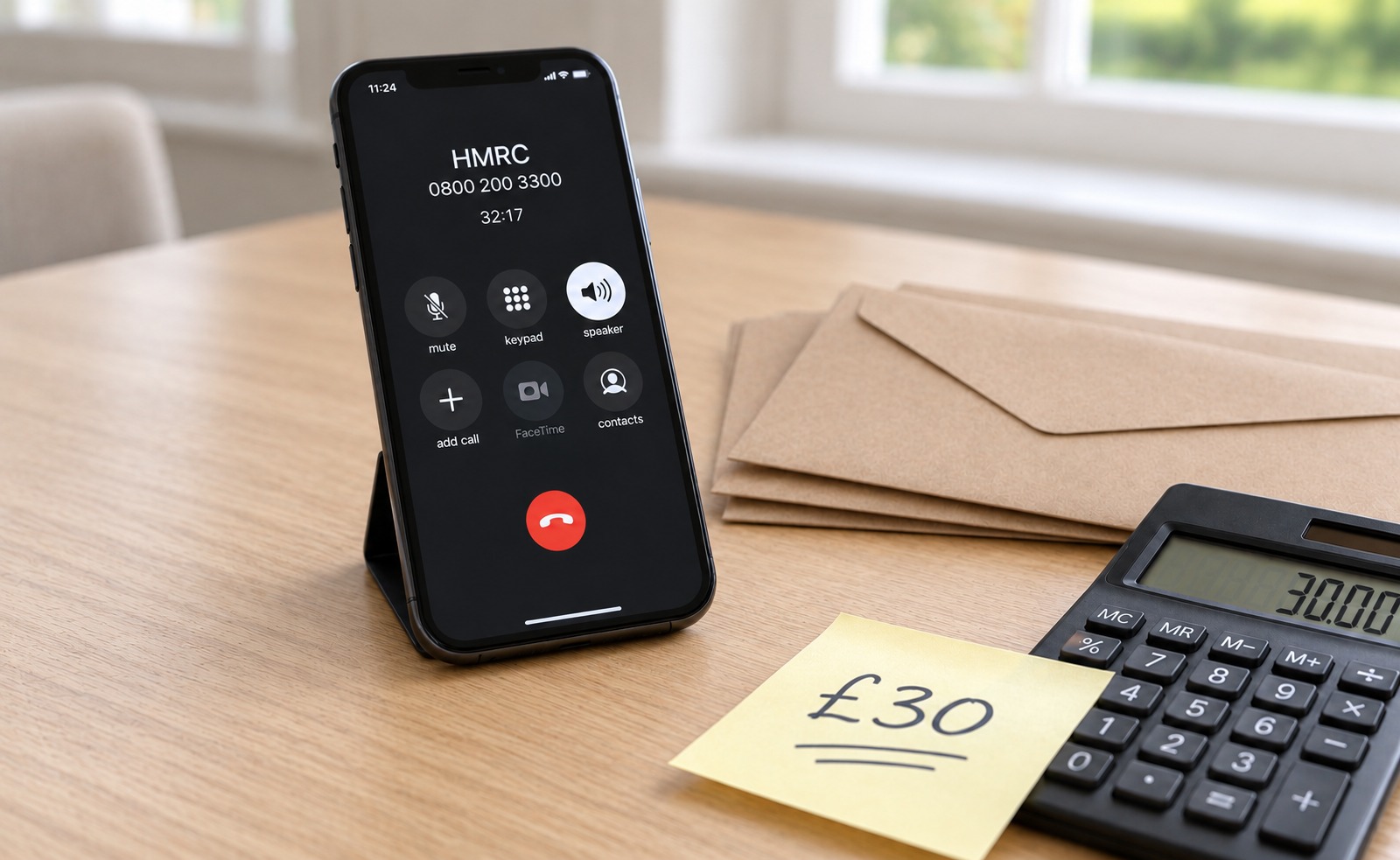
Not all of the phone calls would have broached “IR35,” but Reform’s £30 HMRC phone rebate vow has put a spotlight on a stubborn stat — more than three in 10 calls to HMRC went unanswered in 2023-24, according to a Public Accounts Committee (PAC) report published in January 2025 (only 66.4% of calls were picked up).
Both on and off the committee, MPs have gone further, accusing the UK tax department of allowing telephone services to deteriorate as part of pushing taxpayers towards digital channels.
For contractor limited companies, whose accounting I’ve specialised in for 16 years and who deal with HMRC directly on VAT, corporation tax and PAYE — against fixed statutory deadlines — HMRC’s “All of our advisers are busy at the moment” message isn’t merely background noise. It’s lost productivity, delays to repayments, hours spent chasing answers, and uncertainty in resolving tax affairs.
When did Reform announce the £30 HMRC phone rebate plan?
Reform UK announced the £30 HMRC phone rebate proposal on August 26th 2026, unveiled by Robert Jenrick MP — and it resonates politically precisely because HMRC’s service failures are real.
According to its “Contract with Small Business,” Reform UK (“Reform”) wants to give taxpayers a £30 tax credit if they spend more than 30 minutes waiting for HMRC to answer the phone.
What exactly has Reform promised?
Under “Introducing ‘Delay Repay’ for HMRC Backlogs,” Reform says in the contract that the credit would be limited to two claims per tax year and applied against a taxpayer’s liability rather than paid as cash.
As a political slogan, Reform’s £30 HMRC rebate works. As a policy, it raises more questions than answers.
Is Reform’s £30 credit a fair idea?
There is an intuitive fairness to Reform’s proposal, which at its heart is an attempt to hold HMRC accountable for poor customer service — that ‘service’ which sees a third of HMRC calls go unanswered.
Reform says: “Introducing ‘delay repay’ for HMRC backlogs [is] so the Revenue is incentivised to treat taxpayers with respect.”
Former housing secretary, Mr Jenrick appears to be arguing that if the state wastes a taxpayer’s time, the taxpayer should be compensated. Most organisations — contractor limited company suppliers included — would face consequences if customers were routinely left waiting excessive periods for support.
Why, many will ask, should the tax authority be any different?
Do accountants agree HMRC needs to be held to account?
Many accountants are asking why HMRC should be treated differently to any other organisation with poor customer service — and they also point to a lack of a two-way street between HMRC and the taxpayers it serves.
A manager at the chartered accountancy firm M Rashid Zaman & Co, Saran Khan, posted: “Taxpayers are required to meet strict deadlines, comply with complex regulations and pay taxes on time. In return, they reasonably expect public tax authorities to provide accessible and efficient services.”
What’s missing from Reform’s £30 HMRC phone proposal?
The weakness in Reform’s £30 HMRC phone rebate proposal is that it penalises poor service but offers little indication of how service standards would actually improve.
Solutions-focused limited company suppliers will find that gap glaring in Reform’s (so far) only 466-word proposal. There is little discussion in Reform’s proposal of:
- HMRC staffing
- HMRC call-handling capacity
- Operational reform at HMRC
So does Reform’s £30 idea actually fix the problem?
HMRC could justifiably argue that service levels are improving through greater use of digital channels and an investment starting earlier this year of £1.6bn in technology and upgraded customer service systems, with average call waiting times reportedly falling significantly from the peaks.
According to the PAC’s report, even the average HMRC call waiting time is over 23 minutes.
Significant questions remain over this £30 rebate proposal, raised by a party currently at its lowest poll rating in 18 months (22%, behind both Labour and the Conservatives).
As the boss of an accountancy firm serving limited companies (who’s dealt with HMRC day in and day out since we were formed in 2013), my top three questions for Reform and Mr Jenrick are:
- How will caller waiting times be verified?
- How will disputes be resolved?
- What happens if a taxpayer has little or no tax liability?
Is Reform’s £30 credit as simple as it sounds?
My fear is that the simplicity in the headline appeal of this £30 phone rebate proposal from Reform quickly gives way to complexity in the actual administration it will require.
More fundamentally, the economics of the proposal are questionable — and that’s before even considering the rather caveated projected cost to the taxpayer more generally.
On the total cost of a £30 rebate for a half-hour HMRC phone line wait, Reform says: “The net cost to the Exchequer of this policy depends on how effectively HMRC fixes their response times and how it changes caller behaviour.” But Reform also says: “We estimate the tax credit would cost the Treasury £70million.”
AR Tax Accountants, which, like us, sorts out limited company contractors’ tax affairs, pondered: “I wonder where HMRC is going to get the money to pay for these £30 tax credits? I feel sorry for whoever is going to have to fund this and pick up the tab.”
What does poor HMRC customer service really cost contractor limited companies?
The truth is HMRC is not a commercial company whose profits can be reduced through customer compensation — any credits ultimately come from the public purse. In effect, taxpayers would be compensating other taxpayers.
For a contractor running their own limited company, the real cost of poor HMRC service will never likely be solved by a £30 credit — it’s the billable hours lost to hold music, the VAT reclaim sitting in limbo, the SA102 box query that can’t be resolved before the January 31st 2027 filing deadline.
As Martyn Raftery, a former accountant, summed up this month (September 2026): “Rather than look to improve the service that HMRC provides…[Reform is] going to refund people.”
Do contractors actually want the £30 credit?
My own calculation is that, ultimately, taxpayers and limited company contractors in particular, do not want compensation for bad service from HMRC. They want good service.
Most contractors I’ve mentioned Reform’s £30 phone rebate proposal to in the last few days told me they would gladly forgo a £30 tax credit if:
- their call was answered by HMRC promptly, and
- their reason for ringing got resolved the first time.
First-time resolution is unlikely on IR35 matters, and indeed, the age-old wisdom is not to broach IR35 with its enforcer, even over the phone. For now, HMRC’s focus should perhaps be solely on the first part — answering the phone promptly.
Is HMRC’s phone service improving?
Positively, HMRC’s “telephony target” of answering 85% of taxpayers’ calls appears to be doing something right: 23 minutes to wait to speak to an HMRC adviser fell to 16 minutes 45 seconds for the quarter ending December 31st 2025, according to HMRC’s own performance data.
It’s also positive that Reform is aware of anti-abuse protections being built into its £30 rebate plan, especially if another political party ‘borrows’ Mr Jenrick’s plan. Reform says the tax credit would be limited to two occasions in a given tax year, for example, and only given as a non-refundable tax credit, “so only taxpayers would receive it.”
The bottom line
The real challenge for any government is not inventing ever more creative ways of compensating citizens for administrative failure — it is delivering public services that work well enough that compensation is never needed in the first place.
In that respect, Reform’s proposal succeeds as a headline. Whether it succeeds as a remedy for the contractors and other small business owners actually losing time to HMRC’s phone lines is another question entirely.